Tuesday, February 9, 2016

How to Tie Your Shoes


For quite a while this has been on my mind, and I’ve wanted to write a few words about something we do everyday--and perhaps even bring some enlightenment to a mundane subject.  Yes, I know, you’ve been tying your shoes ever since kindergarten, so why waste time reading about it.  No problem, keep scrolling and read some more opinions about Trump or Clinton, or maybe watch some funny cat videos on YouTube.  Better yet, go for a walk or read a good book.  But wait, before you go, let me ask you a question.  How many times do you need to retie your shoes during the day?  Or do you double-knot them, and then fight with the knot the next time you want to put them on?  How many of you have simply given up, and gone to slip-on shoes, slip-on boots, or velcro straps.  If that’s you, listen up.


There is a better way.


I know.  There have been articles and videos about this,  so I’m certainly not the first to address it.  And some of you have had a good teacher who taught you the correct method, and your shoes stay tied.   But a few of you may find this helpful.
About twenty years ago, our family was planning a canoe trip to the Boundary Waters of Minnesota and Canada.  The thing is, the Boundary Area is not all about canoeing.  There are portages (some of them long and hilly, or muddy, or stony) between the lakes and rivers, and one must hike those trails while carrying a canoe and/or a large backpack.  The last thing you want is a shoelace coming undone.  And more than that, you want good shoes appropriate for the journey.


So we went to an outfitter-type store somewhere north of Wayne County, (can’t remember exactly where) to the shoe section.  I had in mind to buy a good pair of waterproof hiking boots, and began perusing the offerings.  Presently, a large man (that’s putting it kindly, God bless him--he was morbidly obese) ambled over to help.  This wasn’t Walmart.  At this store, the personnel still help with the fitting.  We chose a boot to try on, and he shuffled off to get the correct size.  Soon he was back and with great effort, got to his knees to help me put on the boot.  I slipped my foot into it and he proceeded to instruct me how to lace it up.


Allow me to confess what I was feeling at this point (and shame on me.)  This fellow was about forty-five years old, and looked as if even a short hike might do him in.  So how would he know how to advise me?  What could he possibly know about lacing up boots for hiking?  Truth be told--more than me.  I’ve been grateful ever since that day, and have been ashamed of my quick judgement.  Perhaps as a younger man, this fellow had been an avid hiker, and somehow things had gotten away from him.  Perhaps he had a health condition.  We should never judge a book by it’s cover.  We’ve heard that a thousand times, and it’s still a hard lesson.


Now back to the lacing of the boot.  The man taught me that if I were going to be primarily climbing uphill, there is a different method of lacing and tying than if I were primarily hiking down hill.  And although I’ve used those methods, and they work wonderfully, we won’t get into that right here.  What he taught me of most significance (and you will thank me for this) is how to tie my shoes--you know, the simple knot at the top, the one with bows that we learned how to do when we were five years old.


Most of us have never given a second thought how we do it.  We simply make the first half of a knot, and then the second half.  The second half includes loops of string so the shoe will be easy to untie at the end of the day.  And that’s that.   For a lot of us, the result is a knot that slips, and within a relatively short time, we will be tying our shoes again.


Take a look at your shoe right now.  Do the bows go across your foot or pretty much line up with your toes and ankles?  That’s the test.  If the bows line up with your toes and ankles, you are doing one of two things.  You are tying them several times a day because they come loose, or you’ve resorted to a double knot.  I know this because that was my life until I met the big man at the outdoor sports store.


He watched me tie the boot, and then with a very wide smile he asked the question--actually it was more of a statement.
“Your boots come untied, don’t they.”  
“Yes, they usually do,”  I answered, “so I double-knot them.”
He looked at me knowingly--nodding as he spoke.  “Let me teach you how to tie them so they don’t come loose.”
I was almost offended by his offer, but again, shame on me.
“Do you see how the bows are lining up with your toes and the top of the boot?”
“Yes.”
“That’s a knot that will come loose.”
(Yeah, I already knew that.)
“It’s called a ‘granny’ knot.  What you really want is a ‘square’ knot.  They don’t come loose nearly as easily.”
“What you want to do,” he went on, “is start your knot by doing the first half of it backwards from what you normally do, and then finish the knot the way you normally do it.”
So I tried it.  Sure enough, the bows now went across my foot.
“That’s a square knot,” he said, smiling widely again.  “You’ll like it because your shoes will stay tied.”


And yes, I do like it.  For the last twenty years I have liked it, and never looked back.  If you care to try it, you will like it too.  It might also be good to include here that there are other creative ways to tie a shoe.  I searched the internet last evening, and found several of them.  If you are a long distance runner, you’ve probably  already found some of those methods, but for the rest of us who just want a shoe that stays tied for the day, and is easy to untie at the end of the day, try the method we’ve just described.

Granny knot.  This one will come loose.
Square knot


There’s a lesson in this story too.  Just because we’ve always done something a certain way, doesn’t mean it’s the best way.  Let’s not be afraid to try something new.


-------------------------------------------------------------


Went for a drive again today.  It was nice outside, and people were out working, so we put the camera into action.  Amish farmers are still bringing in corn shocks, and spreading manure.


One Amish fellow rode his bicycle to the filling station at Mt. Eaton for some gasoline.  He was pulling a trailer with two little children in it.


Took a picture of a very poor Swartzentruber homestead.  Most of the Swartzentrubers look a little poor, but this one looks really poor.

Stopped at John Miller’s for some pecan pie and homemade bread.  It’s fun to stop there.  The boys pop out from everywhere.  I asked one of the older boys, William, how many boys are in the family.  “Seven boys and seven girls,” he said. Then I went to the shop to visit with John a little.  He was building a buggy (that’s what he does for a living), and he thought I might like to see a new hack that was sitting outside. (A hack is an Amish truck).  Anyway, the hack had torsion-bar springs for suspension.  He said it will ride nicer and be more stable going down the road.  I told him that was pretty fancy for a Swartzentruber, and he just laughed.  That was a new one for me.  Maybe there are a lot of springs out there like that, I don’t know, but most buggies have leaf springs.  
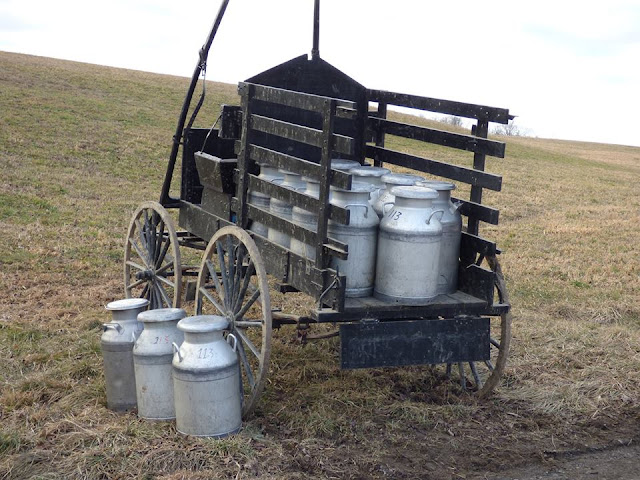
This is a typical Swartzentruber Amish hack. Looks like the cows are milking pretty good. These are ten-gallon cans, and every drop of milk in them was squeezed out by hand.


And that’s about it for today.  Looks like the weather is going to turn cold next week, and then on Saturday we’re planning to tap the maple trees.  It’s that time again.  Son Mike and I are putting together a reverse osmosis system this year to remove a lot of the water from the sap before cooking it down.  Should speed things up considerably.  We’ll see.


From Kidron, Ohio; where the men are homely but hard-working;  where the women are beautiful, and patient with their men; and fortunately, where the happy, energetic children look a lot like their mothers.  Have a wonderful weekend.  So long.


Saturday, February 6, 2016

The Earl I knew. A friend. A mentor. A flower.

I’ve been thinking about my old friend Earl a lot in the last days and weeks.   He passed away last week at the age of eighty-five after a short illness.  Our friendship began when I was a shy eighteen-year-old and Earl was around forty years old, a busy father of seven, with number eight on the way.  Earl was a Mennonite too, but of the Conservative branch.
Meeting Earl.  We lived in Hartville, Ohio, in those days, where Dad was the pastor at the Hartville Mennonite Church.  I had just graduated from High School and was looking for my first full time job.  Dad thought I should apply for work at the F. E. Shumacher Mfg. plant.  I did, and they hired me, putting me with Earl to assemble aluminum storm doors.  I was nervous, beginning a new job, but Earl made it easy for me.  Outgoing and friendly, and generous with instructions, we soon fell into a workable pattern of door production - a team that enjoyed competing to see who could get their side finished the quickest.  
Music.  It didn't take long to figure out that here was a man who loved music.  He loved to listen to it, and he loved to sing.  His tenor rang clear and true as we worked together and harmonized on old hymns.  He also loved to trumpet songs with his lips.  With his eyebrows raised high, and a grin on his face, he produced a sound that clearly rivaled the brass instrument.  Not as much volume, but just as pretty.  It took imagination and practice to do that, and since he didn’t own a real trumpet, he made do with the instruments that God gave him.
Earl soon invited me to his home.  There I met his wife Maggie and their delightful and happy brood, and was sometimes even treated to an excellent impromptu girls trio made up of his three oldest children.
And then the hand saw.  Earl pulled the saw out from somewhere one day when I was at his home, pinched it between his knees, and proceeded to wail out a tune on it.  From that day on, I wanted to do the same.
Faith.  Earl’s faith was front and center.  That was good for me, a young man who was beginning to test the waters.  Having been raised in the Mennonite Church and taught the same Christian faith from a Mennonite perspective, we had a lot in common.  Our branch of Mennonites was less conservative in appearance than Earl’s, and I appreciated that he didn’t try to convince me that I should be a Conservative Mennonite.  He accepted me the way I was, with the faith that I had, and helped build on that by sharing his own life and faith in a way that was transparent and refreshing - a truly childlike faith.  There has never been another person who has been that open with me, not before and not since.  Earl was an open book, and for a shy young man to hear his stories of life, his hard times, his good times, his deep love for his wife Maggie, and his love and concern for his children… that was a gift.  A true gift.
Jokes.  One of the most delightful features about Earl was his considerable appreciation for (clean) jokes and riddles.  It was always great fun to hear a good one and then to share it with Earl.  His immediate and full-blown laughter was a sight to behold - a mirth so complete, so enjoyable to observe and hear, that it often eclipsed the joke itself.  For the last forty-some years, every time I've heard a good one, I've thought of Earl and wished I could tell it to him - often writing them down in the hopes that I might be able to share them with him sometime.
A couple summers ago I bumped into Earl and his daughter Marjorie at the Mennonite Relief Sale in Dalton, Ohio on a Friday evening.  Earl was in his eighties now, and had lost his dear wife Maggie a year earlier.  His walking wasn’t very steady, so we borrowed a wheelchair for him.  While Marjorie headed out for some food, I rolled Earl to the spot where he wanted to sit for the program - the front row on the right - then went to grab a bite for myself too.  It was nearly time for the program to start when I returned to sit next to Earl, and to my surprise, he was sitting there, already having a one-man program of his own, belting out some tunes on his harmonica.  He grinned widely and chuckled as the instrument found its way back into the inner pocket of his straight-cut coat.
“Yes,” I said to myself, “this delightful man is still the same Earl, and in another day or another time, he could well have been one of those sharing his talents on stage.”  It was a pleasure to sit with him while John Schmid entertained the audience with stories and songs of faith.   Earl thoroughly enjoyed music, and his joy still shone through his smiling face and clear blue eyes.


Wallpaper.  There are many ways to decorate the walls of a house and make it home.  For some, the simplicity of plain pastels are the best choice.  For others, nothing less than beautiful wall paper will do.
In the large dining room of the old farmhouse we occupied for twenty years while our children were growing up, the walls were covered with floral paper.  The background was a light buttery yellow, and the patterns were mauve-colored flowers and gently creeping vines.  There were many times when I'd lay on the soft carpet of the old dining room, worn out from work, or needing a rest from the heat.  A pillow would be tucked under my head, and I'd lay there and think.  The floor is a good place to do that.  Barely comfortable enough to sleep, but good enough to rest while the mind churns with thoughts about life and reflections of days gone by.  While I was staring at the wallpaper one day, it occurred to me that most of us are like the background, and a few are like the flowers.  We need each other to complete the picture, but the flowers are what bring beauty to a space.  And that brought to mind individuals I have known who have brought color and beauty into my life.  Earl was one of them.  He was one of the flowers.  A rare one whose transparent love and hospitality shone like the bright yellow daffodils of springtime, glistening in the morning sunshine.  He bloomed where he was planted in a drab world, making it a better place.  He will not be forgotten.
So long, old friend.

Earl and Maggie.  Together again.
-------------------------------------------------------
As I was out and about today, I observed my Amish neighbors doing some January work.  Some were gathering and chopping corn shocks for bedding, and others were cleaning out the barns and spreading manure.  It was a very mild day today - reaching into the 50’s.  Won’t be long until we’ll be tapping the maple trees.  And then spring time.  
The family dog is following along.  Look behind the right rear wheel.
Gathering in the shocks.  These will be chopped up for bedding in the barn.
A load coming in, heading for the chopper.  The ears of corn were shucked last fall.  These are just the stalks.

From Kidron, Ohio, have a wonderful weekend.


Monday, January 25, 2016

Amish Ice

Finally we have some cold weather.  People are beginning to skate on the ponds around here.  For quite a while it seemed there would be no ice.  We’re not getting any of the snow that is piling high in the northeast though.  Some southern parts of Ohio are getting a nice thick blanket, and (dare I say it?) I’m a little envious.  A good snow a couple times in the winter is really pretty.


Went for a long walk today, and my Stutzman neighbors were back at the pond behind the Jericho Amish school, cutting ice for their ice-house.  I hiked back to watch them for a while and asked if I could get some pictures.  No problem as long as they aren’t in them.  Well, I snuck a couple of them in anyway... from a distance… without faces showing… sort of.  


Last year when I saw them cutting ice, I asked how long it would last.  They said probably until September.  So today I asked them if it really lasted until September last year.  Yes it did.
They have an old insulated truck body inside a corrugated metal building.  The  building is about one foot larger than the body all the way around, and that area is packed with sawdust for more insulation.  It’s a good system for the Swartzentruber Amish.  They have refrigeration for all summer and into the cooler weather of fall.


Mr. Stutzman, the father, was sawing the ice, and his teenage boys were loading it on the wagon.  They were working hard and fast.  I mentioned to them that loading the ice must be making them warm.  They laughed, “Yes,” one of them replied, “The ice makes us warm in the winter and cool in the summer.”  And with that, they kept on loading the ice as fast as they could.  The day was waning, and they really couldn’t burn any more daylight talking with an Englishman.  Good people, they are.  Our short conversations are always a pleasure.


That’s enough for today.  Thought you might enjoy the pictures, so we’ll let them do the talking.

Pulling up to the pond to get a load of ice blocks
Loading the ice blocks while Mr. Stutzman is cutting more of them.
Measuring the thickness of the ice.  It was about eight inches thick.
Beginning the load.
Close up view.  The blocks are approximately 8 x 12 x 12 inches.
Heading up the road with two layers of ice blocks.  Pretty heavy load.
The ice house is the gray building next to the buggy shed.
Closer view.
The ice blocks get shoved on a board that leads into the ice-house.  Another brother is inside stacking the blocks.

The cutting machine.  The two-foot diameter blade has been removed.

A rope is tied to the post in case anyone falls into the pond.

So long from Kidron, Ohio.  Have a wonderful weekend!  

Sunday, January 17, 2016

Making Butter


Making butter is not that big of a deal is it?  I mean, why bother when you can pick up a few sticks at the grocery store and you’re all set for some some delicious buttered toast, maybe even with a sprinkle of cinnamon and sugar on it.  But watch out, for we all know how unhealthy butter is. We learned this quite a few years ago when the makers of margarine convinced us to use their product.

Well, my friends, we drank that Kool Aid for way too long.  I can hardly believe how misled we were.  We were somehow sold the bill of goods that oleo margarine was better for us than real butter.   And to make matters worse, some folks were even using raw milk to make their own butter!  

To think that my caring mother and father were willing to risk our lives by feeding us raw Jersey milk, homemade cottage cheese, and homemade butter--all from our Jersey cow, Pogey, who ate grass and hay, along with some chopped corn and oats.  How did we survive?!  It’s a travesty, I tell ya.

But wait, my Amish friends still do these things and somehow they are healthy and strong.  When Jacob’s family moved to southern Ohio a few weeks ago, they sold their dairy cows because there is no market for grade B milk in that area.  Around here there are still a couple cheese factories that will buy it and turn it into delicious swiss cheese.  When I asked Jacob what they will do for family milk, he said they hope to buy a Jersey cow.  I smiled knowingly.  That’s what I grew up on too.  It’s the best.  Rich with lots of cream for making butter, and plenty of milk for making cottage cheese and drinking, or putting on cereal, or potato soup, or pudding, or...you name it.

Last week when I stopped at Swartzentruber Amish John Miller’s for some baked goods (a pecan pie and a loaf of bread) his boys were out doing work that needed to be done.  No one stands around in this family with their head bowed low, eyes staring at a tiny screen, and thumbs bouncing around on letters.  Nope.  At this farm the fun and games are called “work.”  One boy was pitching manure into a spreader, and several others were stacking wood.  John was in his shop building a buggy and peering out the window at the englisher walking towards his house.  I glanced over my shoulder and saw him looking out the window, so I waved a friendly greeting.  

I spoke with the boy who was pitching the manure and asked him what they do for family milk.  He pointed toward a doorway at the other side of the barn.  “We have a Jersey cow,” he said.  Sure enough, there she was peeking around the doorway, curiously watching the proceedings, and hoping for a handout.  Not much grass out there this time of year, so she looked a little eager to be fed some hay.  I asked the young man if she can give enough milk for the family.  Remember, this is a family of fourteen children plus mom and pop.  
“Yes, she gives more than we need.”
The wheels started turning in my head.  I’d love to get some of that fresh raw milk, and maybe make some butter and cottage cheese like Mom used to when I was a boy.  But unfortunately, the allwise powers-that-be have decided that raw milk cannot be sold straight off the farm.  Never mind that we know the risks.  So what if we don’t care.  It doesn’t matter.  Nope.  We, with our low intelligence and high susceptibility to unwittingly and naively purchase goods that might poison us, must be “protected” by big brother.

Enough sarcasm, I suppose.  But it is disconcerting that we cannot be considered intelligent enough to make our own informed decisions.  Yes, I know there are ways to get around this.  Many families share a cow and share the milk.  Others have friends who can be trusted, and the milk can be bartered or sold under the table.  But for most of us, it is only a dream to return to healthy raw milk.

Anyway, back to the title.  “Making Butter.”  A few days ago, I noticed a carton in the back of the fridge that had been there quite a while.  One quart of Smith’s Dairy heavy whipping cream.  Again, the wheels started turning.  I have fond memories of the bright yellow Jersey butter that Mom used to make, and I can still see her sitting on a chair, with a bowl in her lap, and a large lump of butter in the bowl.  With a wide, curved, wooden paddle, she’d “work” the lump of butter and push out the remaining droplets of butter milk.  At the same time, she’d have salted it, and the working of the butter served to also stir in the salt.  Can I tell you how delicious homemade butter is when it is fresh?  Some of you know that, and the rest will have to take my word for it. It is amazing on fresh homemade bread or toast.

So what did I do with the heavy whipping cream that now sat on my kitchen counter?  First off, I checked the date on the carton.  Oops.  Slightly out-dated.  Expiration date of July 5, 2015.  I kid you not!  I knew it was in there a long time, but six months!  Oh well, what would it hurt to open the carton and take a whiff.  I was prepared for the worst.  But whadaya know!  It smelled as fresh as a daisy, and looked good too.  I suppose that was because of words printed on the carton that said “ultra pasteurized.”  That’s a process that kills all the bacteria, the good along with the bad.  

Now from the reading I’ve done on this subject, ultra pasteurized cream is not what a health nut wants to use to make butter.  But opportunity was knocking, and on top of that, I am easily bored with the mundane.  I determined that this container of heavy whipping cream was going to be butter, or bust.  Juanita wasn’t home to add an element of common sense to the equation, so with enthusiasm gaining momentum, and a quart of heavy cream waiting to morph into something I could spread on hot toast, I barged ahead.

My good wife requested a new mixer a while back, and we decided to go with a sturdy (though expensive) Kitchenaid.  This puppy has enough power to do what the cheaper models can only hope for.  If you have the right attachments, it can even grind meat and stuff sausage.  I suppose if it were rigged properly, it could even be added to a machine shop, and be used as a drill press and boring mill.  There’s probably not much it couldn’t do.  The point is, though, that it is plenty powerful enough to churn butter.

I put the whisk attachment on the mixer, and poured the cream into the bowl.  With the speed set on number four, I settled back into my nearby chair and waited expectantly.  Every so often a glance in the bowl would tell me what was happening.  After about 12 minutes, the former heavy cream had become a very lovely, pure white whipped cream.  I tasted it.  Sorta flat.  It needed sugar if it were to be used on a pie.  But I wanted butter, so back to number four and more waiting.  It was interesting to see the whipped cream begin to form into a mass of tiny yellow nuggets, and at the same time a watery substance began appearing in the mix.  Nearly done.  I switched to a different attachment - the regular flat “beater.”  And it didn’t take long.  All of a sudden there was a mass of butter on the beater, and a lot of butter milk sloshing (splashing) around in the bowl - some of it finding its way out of the bowl.  Not to worry.  I am good at cleaning up messes.

A quart of cream became a pound of butter, and a pint of buttermilk.
Now I could see in my mind’s eye what Mom used to do.  I knew that the butter should be rinsed with fresh water, and worked until all the buttermilk was squeezed out.  And lo and behold, a few minutes later, I was the proud owner of a ball of butter that less than an hour ago was a lonesome carton of heavy whipping cream, hidden behind the orange juice and Juanita’s large container of Hazelnut coffee creamer.  I was as proud as a peacock.


I called my ninety-seven-year-old Mom and told her all about it.  She laughed and laughed, and said, “What are you going to do next?”  
“I don’t know Mom, but I guess I’m like you.  I love to try new things.   It beats boredom.  But don’t worry, I won’t be jumping out of an airplane any time soon.”

Now here’s another tidbit.  After the butter was in the fridge for a while, I got it out and wanted to spread it on some toast.  It seemed harder than store-bought butter.  I wondered why.  So google came to my rescue.  Butter made at home is higher in butterfat.  This is because processed, store-bought butter can have the butterfat content reduced with an infusion of water as long as it is at least eighty percent butterfat.   Shame on ‘em.  I really need to get a Jersey cow!

And that’s all from the lovely land of Kidron, Ohio.  Hope your year is starting out wonderfully!

So long.


Monday, December 21, 2015

You've Never Tasted Peanut Brittle This Good


Dad was a multi-talented individual who became best known for his many years as a pastor.  But that didn’t start until he was forty-six years old.  Before that he had been a farm boy, a factory worker, owned a gas delivery business with a brother-in-law, and finally worked for quite a few years at the Lima Lumber Company—working his way up from deliveryman, to sales and management.  After he was called to be a pastor in Wayne County, Ohio, he needed to keep on working because the church was small and could not provide full support.  So Dad briefly tried his hand at being a building contractor, before moving again to sales in a local lumber company, and then establishing a building supply business for the Walter Jones Construction Company of Wooster.  He was a success at this, but after a few years he was called into a full-time, full-paid pastorate at the large Hartville Mennonite Church.

Probably due to his growing up on a large farm, Dad was good at many things, including carpentry, fencing, field work, taking care of animals, painting, repairing things, and just in general, making things better than what he found them.  He was a man with a plan, and never were his hands or mind idle.  I’m thankful that he pushed us to work with him and for him, and we learned a lot.

One thing Dad did not do—he did not cook.  Can’t really fault him for this though, because our home was a traditional one, and Mom loved cooking for the family.  There was one small hitch in the family plan however.  Mom and Dad had six boys, and no girls to help in the kitchen.  So we learned that it’s okay for boys to spend time helping out in the kitchen, cooking some basic things, setting the table, doing the dishes, and mopping up our messes.   These are skills that some of us have continued, and our wives appreciate it.   In Dad’s defense though, I  suppose in a pinch he could have fried eggs or cooked hotdogs if he needed to, but he never needed to.
Dad did love spending time in the kitchen though—eating Mom’s good cooking and conversing with the family while we ate.  He taught us how to say a blessing for the food, and we took turns doing that.  And he taught us table manners, like passing the food, no arguing, saying please and thank you when we wanted more of something, and definitely no farting while at the table.  These are important things to learn.

* * * * *

Last Saturday, while transporting Jacob and his family to southern Ohio, I brought some molasses crinkle cookies along to share with them while traveling.  He was a little surprised to learn that I had baked the cookies.  Amish families are very traditional with respect to a division of duties and expectations between the men and women.  It may be that some men would enjoy cooking, but as far as I know, this is left to the women and girls.  There may be exceptions, I don’t know.

In our conversation, as we motored down the road, I mentioned to Jacob that I had seen a couple butchered hogs hanging from tripods in his backyard a few weeks ago.  “Yes,” he said, “we wanted to get them butchered and make sausage before we moved.”
That made me wonder about something else, so I asked him.
“Do you use the hog’s small intestine as casings for the sausage?”
“Yes we do.”
So now I had another question.
“How do you clean out the intestines to get them ready for stuffing with sausage.”
His reply surprised me. “I don’t know.  The women do that.  I think they have to wash them out and scrape them.”

So wouldn’t you like to be an Amish woman?  They do a lot of chicken butchering too.  In fact, we’ve had Jacob’s family butcher some for us in years past, and it’s always the women doing it while the men are working out in the fields.  The women help with the milking too.  Never a moment to relax, it seems.  The sturdy Amish women are skilled at many things, including cooking, raising babies, and doing a lot of work that we might think only men would do.

So what in the world does all this have to do with peanut brittle?  Well, I’ve chosen to get there in a roundabout way.  I didn’t grow up with a Dad who did things in the kitchen, so as a young married man, I supposed that I would not be doing much in the kitchen either.  Those things I had learned from my mom—I thought my wife would be doing them now.  And she’s done a good job over the years, but I’ve learned that I enjoy spending time in the kitchen too.  Cooking can be fun, especially when it comes to the sweet stuff.  Now to the peanut brittle.

brittle.jpg

I never really cared much for peanut brittle—that is until an older co-worker introduced me to a recipe handed down to him long ago.  He said he enjoyed making it at deer camp each year, and brought a batch to share at our workplace too.  It was amazing!  Crispy and delicious, it melts in your mouth, with nothing sticking to your teeth.  Only 5 ingredients.  Peanuts, sugar, karo syrup, salt, and soda.  The secret though, according to him, is using a cast-iron skillet and a wooden spoon.

He shared the recipe with me, and for the last thirty-five years (until I, too, have become an older man) I’ve been producing quite a few batches each Christmas season.  It’s not difficult.  It takes no “stretching” of the brittle, and less than 15 minutes from start to finish.

List of ingredients for each batch:

1 C white sugar
1 C karo syrup
1-½ C Raw peanuts.  (Raw blanched peanuts.  Available in bulk food stores or on the internet.)
¾ tsp salt
1-½ tsp soda
10” cast iron skillet
Wooden spoon.

Before you start:

1)  Measure out the soda, and keep it on standby.

2) Have a greased cookie sheet or pizza pan nearby on a hot pad.

3)  Make sure an empty kitchen sink is available or you will have scorched brittle in your skillet.
Put all ingredients except soda into the skillet and turn the stove on high (for gas) or med-high (for electric.)

pan.jpg


Stir occasionally as the ingredients begin heating up.   Stir continuously after it comes to a good boil.

mid.jpg

This batch is about half-way there.  Boiling nicely.  Keep stirring.


The brittle is finished and ready for the soda when you notice these things:
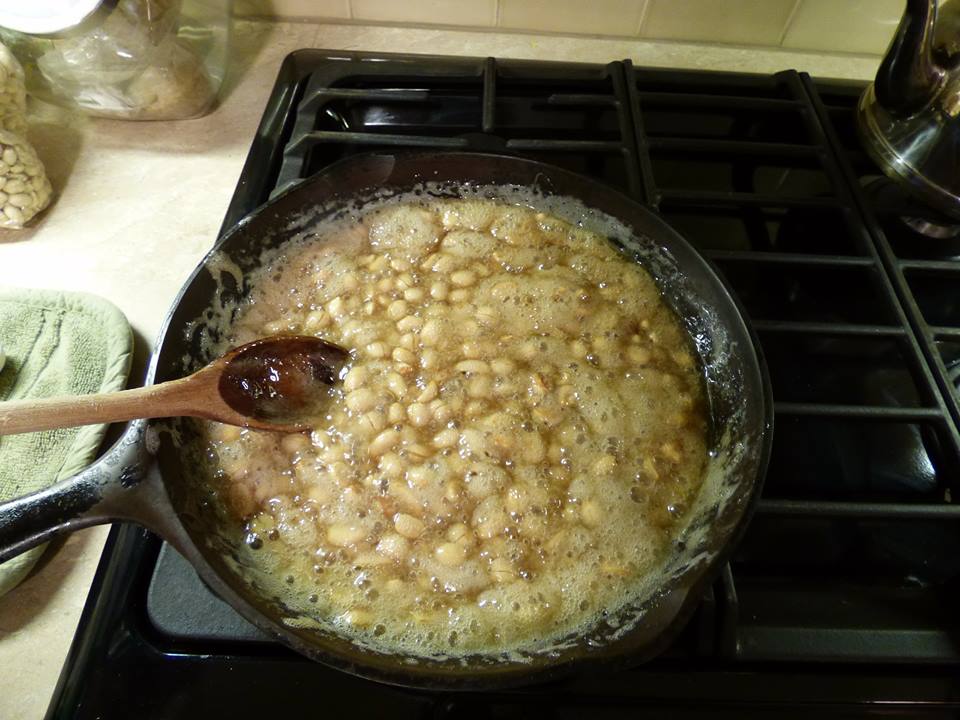
The color is turning amber, the peanuts begin splitting, and you can smell the roasting peanuts. (On my gas stove, it takes exactly twelve minutes.)

done.jpg


Turn off the heat, add the soda, and stir rapidly, but not for long.  The brittle will foam up nicely.  Immediately, before it scorches, dump it onto the cookie sheet and let it spread out and settle down on its own.

foam.jpg


Put the skillet in the sink and fill it with hot water.  The heat from the skillet and the hot water will very rapidly melt off the remaining brittle.  Use a scrubber to easily finish cleaning it up, and you are ready for the next batch.

sink.jpg


sheet.jpg

Let the brittle cool down.  Turn the whole “cake” upside down on the cookie sheet, and crack it with the handle of a table knife.

Enjoy.

And that’s all from Kidron, Ohio, on this chilly, breezy evening.  The homely men and lovely women are busy getting ready for Christmas.  The children are staring at the gifts under the tree, and guessing what may be in them.   Have a blessed weekend, and a wonderful Christmas Season with family.